

Issue #18: The Galactic Heartbeat
The turbulent anatomy of a starburst

Today we zoom out to the central kiloparsec of NGC 0253, the nearest starburst galaxy to our own. This figure is a beautiful synthesis of data and artistry, turning complex multi-wavelength observations into a readable map of cosmic chaos. It captures a moment of intense transformation where the birth of new stars is so violent that it physically reshapes the galaxy, pushing vast plumes of gas out into the void. It is a striking example of Astrophysical Data Déco, where invisible physical environments are rendered as overlapping, translucent layers of light.
“The stars are golden fruit upon a tree
All out of reach.”George Eliot
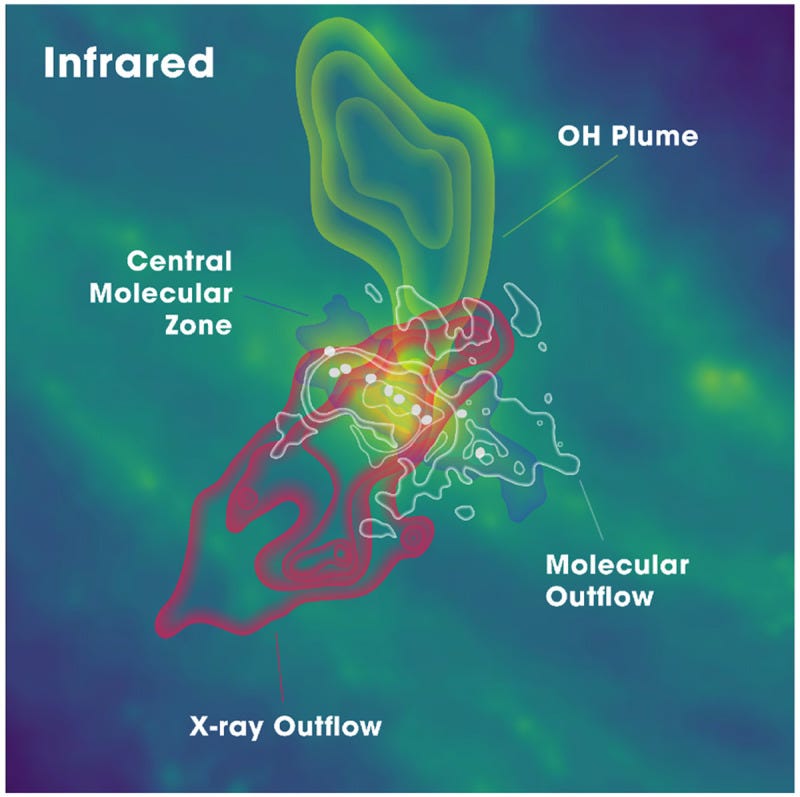
The beauty of this figure lies in its use of "visual shorthand" to explain extreme physics. Set against a deep emerald and violet infrared background, the central molecular zone (CMZ) is highlighted as the glowing core where the action begins. The composition uses bold, color-coded contours to represent different outflowing materials. A vibrant lime-green plume represents OH gas rising vertically, while fiery red contours trace the path of high-energy X-ray outflows. These are intersected by delicate white outlines marking the "molecular outflow," showing how the galaxy’s own star formation acts as a cosmic leaf-blower, clearing out the fuel for future stars. By stacking these distinct environments like stained glass, the figure reveals the structural elegance of a galactic-scale explosion.
Know a figure that belongs in this gallery? We’re always looking for the next masterpiece: send us your recommendations.
If you enjoyed today’s view, why not share the beauty? Forward this to a friend or Subscribe here to ensure you never miss a dose of peer-reviewed eye candy.
Stay hungry and stay foolish,
Giulio