

Issue #8: The "Good Boy" Gradient
The fine art of canine frustration.

Science usually asks the "big" questions: the origin of the universe, the structure of the brain, the future of the climate. But today, we tackle the most critical research of our time: What does a frustrated Labrador look like? This figure is a hilarious yet sophisticated example of how researchers train AI to translate the silent language of our best friends.
“Perchance my dog will whine in vain
Till fed by stranger hands;
But long ere I come back again
He’d tear me where he stands.”Lord Byron
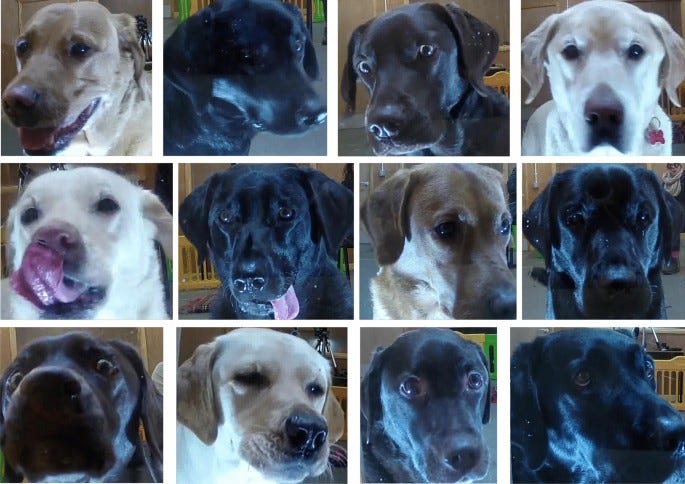
This grid is more than just a collection of very good dogs; it’s a standardized dataset used to teach machines the difference between "Positive Anticipation" (I’m getting a treat!) and "Frustration" (Why haven't you given me the treat yet?). The beauty here is in the repetition and variation. Like an Andy Warhol pop-art piece, the grid layout highlights the subtle shifts in "eye-white" exposure, ear position, and the infamous "tongue flick." From the wide-eyed side-eye in the top row to the soulful, direct stares in the bottom, these frames prove that biological data can be both statistically significant and undeniably charming. It’s a reminder that even the most complex emotional states can be mapped, frame by frame, into a gallery of high-resolution "mlem."
Know a figure that belongs in this gallery? We’re always looking for the next masterpiece: send us your recommendations.
If you enjoyed today’s view, why not share the beauty? Forward this to a friend or Subscribe here to ensure you never miss a dose of peer-reviewed eye candy.
Stay hungry and stay foolish,
Giulio